
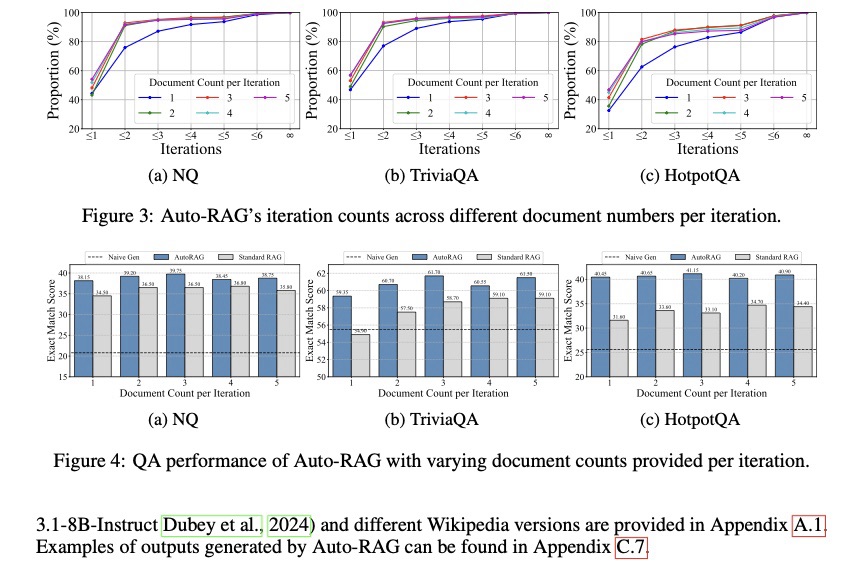
The paper “Auto-RAG: Autonomous Retrieval-Augmented Generation for Large Language Models” introduces an innovative approach to enhance Retrieval-Augmented Generation (RAG) systems by leveraging the decision-making capabilities of Large Language Models (LLMs). The authors propose an autonomous iterative retrieval model, Auto-RAG, which engages in multi-turn dialogues with retrievers to systematically plan retrievals and refine queries, thereby acquiring valuable knowledge. This process continues until sufficient external information is gathered to generate a final answer.
From the methodologies and strategies discussed in the paper, we can extract the following five patterns:
1. Autonomous Iterative Retrieval: Auto-RAG enables LLMs to autonomously decide when and what to retrieve through reasoning, engaging in multi-turn dialogues with retrievers to systematically plan retrievals and refine queries.
2. Reasoning-Based Decision-Making: The model employs reasoning for retrieval planning, extracting valuable external knowledge, identifying information needs, and rewriting queries, effectively leveraging the remarkable reasoning and decision-making abilities of LLMs.
3. Dynamic Adjustment of Iterations: Auto-RAG can autonomously adjust the number of retrieval iterations based on the difficulty of the questions and the utility of the retrieved knowledge, without requiring any human intervention.
4. Natural Language Interpretability: The iterative retrieval process is expressed in natural language, enhancing interpretability and providing users with a more intuitive experience.
5. Fine-Tuning with Synthesized Instructions: The authors develop a method for autonomously synthesizing reasoning-based decision-making instructions in iterative retrieval and fine-tune the latest open-source LLMs to empower them with autonomous decision-making capabilities.
These patterns collectively contribute to the effectiveness of Auto-RAG in improving the performance of RAG systems across various benchmarks.
Here are five l patterns that align with the concepts
Pattern Name: Iterative Retrieval Optimization
Pattern Type: Decision-Augmented Retrieval
Context/Background:
When interacting with a vast corpus of documents, LLMs may need multiple iterations of refined query processing to retrieve the most relevant information. However, a non-optimized retrieval loop can lead to inefficiencies.
Forces:
• Need for high precision in retrieval without overwhelming latency.
• Trade-offs between retrieval accuracy and computational cost.
Solution Overview:
Integrate iterative refinement steps where the LLM evaluates and adjusts its query parameters dynamically based on intermediate results, optimizing future retrievals.
Actionable Steps:
1. Generate the initial query.
2. Retrieve preliminary documents or snippets.
3. Evaluate retrieved information for relevance.
4. Update query with refinements based on evaluation.
5. Repeat steps 2-4 until an objective threshold is met.
Pattern Name: Auto-Retrieval Decision Loops
Pattern Type: Adaptive Automation
Context/Background:
LLMs can act as decision-makers in an autonomous retrieval system, selecting retrieval pathways dynamically. Without clear decision loops, retrieval can become misaligned with the user’s goals.
Forces:
• Trade-off between maintaining autonomy and user guidance.
• Risk of losing context fidelity over multiple iterations.
Solution Overview:
Embed clear decision loops into retrieval processes, where the LLM autonomously decides on query refinements or terminates iterations when goals are met.
Actionable Steps:
1. Define a goal for the retrieval task.
2. Execute initial retrieval.
3. Evaluate results and decide to refine, expand, or terminate.
4. If refine or expand, re-run with updated context.
5. Terminate when the relevance exceeds the threshold.
Pattern Name: Context-Driven Weight Adjustment
Pattern Type: Contextual Retrieval Optimization
Context/Background:
When integrating LLMs with RAG models, the model must prioritize documents based on relevance while managing noisy data sources.
Forces:
• Relevance degradation due to broad query parameters.
• Inefficient utilization of computational resources.
Solution Overview:
Utilize LLMs to adjust the weights of retrieved documents dynamically, prioritizing contextually relevant results in subsequent iterations.
Actionable Steps:
1. Retrieve documents from the initial query.
2. Score documents based on contextual relevance.
3. Adjust weights dynamically and re-rank documents.
4. Use re-ranked documents to refine the next iteration.
Pattern Name: Autonomous Query Generation
Pattern Type: Query Adaptation Pattern
Context/Background:
Standard retrieval systems rely on static or pre-defined queries. Autonomous query generation enhances the RAG model by dynamically altering queries for better alignment with evolving retrieval goals.
Forces:
• Difficulty in predicting the most effective initial query.
• Need to adapt queries for diverse and complex domains.
Solution Overview:
Use the LLM to autonomously generate queries in iterations, guided by intermediate results and goal alignment metrics.
Actionable Steps:
1. Analyze user input and objectives.
2. Generate an initial query using contextual embedding.
3. Retrieve and evaluate results.
4. Generate a refined query based on result gaps.
5. Iterate until desired outcomes are achieved.
Pattern Name: Hierarchical Retrieval Pathways
Pattern Type: Multi-Stage Retrieval Framework
Context/Background:
Retrieval processes often require navigating multiple layers of information, where each layer informs the next. Without hierarchy, retrieval results may lack depth.
Forces:
• Need to balance broad exploratory retrieval with focused deep dives.
• Difficulty maintaining coherence across retrieval layers.
Solution Overview:
Design retrieval pathways in hierarchical stages, with each stage progressively refining the scope of results using LLM-guided criteria.
Actionable Steps:
1. Conduct a broad exploratory search.
2. Cluster results by thematic categories.
3. Use clusters to inform focused, in-depth queries.
4. Iterate with refined scopes until goals are met.
Source : https://arxiv.org/abs/2411.19443

 AI Patterns