Blog

Uncategorized

Enhancing Large Reasoning Models with Agentic Patterns

In the research “Search-o1: Agentic Search-Enhanced Large Reasoning Models”, several innovative patterns were introduced to address the challenges of large reasoning models (LRMs) in extended reasoning tasks. Below, I’ve detailed five key patterns, formatted according to the structure you taught me.

1. Pattern: Agentic Retrieval-Augmented Generation (RAG)

• Pattern Type: Augmentation Pattern

• Context/Background:

Large reasoning models often face knowledge insufficiencies during complex reasoning tasks. These gaps can result in inaccuracies and limited reliability.

• Forces in the Problem Space:

• Lack of in-context knowledge affects reasoning flow.

• Over-reliance on static datasets limits adaptability.

• Knowledge retrieval must balance relevance and efficiency.

• Solution Overview:

Enable LRMs to autonomously retrieve external information during reasoning, enhancing their knowledge base.

• Solution in Ten Steps:

1. Detect knowledge gaps through uncertainty markers in reasoning.

2. Define a retrieval query based on the reasoning context.

3. Access external resources (search engines, vector databases, etc.).

4. Retrieve relevant documents or information.

5. Filter for quality and contextual alignment.

6. Synthesize the retrieved knowledge into the reasoning chain.

7. Reevaluate the reasoning process with the augmented knowledge.

8. Iterate retrieval if uncertainties persist.

9. Optimize the retrieval process for efficiency.

10. Return a refined, knowledge-enhanced output.

• Implementation:

Integrate retrieval APIs (e.g., Bing or Elasticsearch) with the LRM’s reasoning pipeline. Use retrieval-augmented generation frameworks like RAG with fine-tuning for domain-specific applications.

• Resulting Consequences:

• Enhanced reasoning accuracy and completeness.

• Reduced uncertainty during complex tasks.

• Increased computational costs for real-time retrieval.

• Related Patterns:

• Dynamic Retrieval Integration.

• Knowledge Graph Enhancement.

2. Pattern: Reason-in-Documents Module

• Pattern Type: Information Processing Pattern

• Context/Background:

Retrieved documents often contain extraneous or noisy data that can mislead the reasoning process.

• Forces in the Problem Space:

• Excessive information can overwhelm LRMs.

• Filtering information must retain relevance without oversimplification.

• Solution Overview:

Incorporate a module that deeply analyzes and refines retrieved documents for relevance and quality before integration into the reasoning chain.

• Solution in Ten Steps:

1. Input retrieved documents into the module.

2. Tokenize and structure the document content.

3. Rank sentences or paragraphs by relevance to the query.

4. Summarize lengthy sections into concise, relevant points.

5. Eliminate redundancies and low-quality data.

6. Identify key facts or data points.

7. Contextualize the refined data with the reasoning task.

8. Reintegrate the processed information into the reasoning chain.

9. Validate the revised reasoning against the task objectives.

10. Output a filtered and contextually relevant response.

• Implementation:

Use document ranking and summarization tools like BM25, BERT, or GPT fine-tuned for document processing tasks.

• Resulting Consequences:

• Noise reduction in reasoning processes.

• Improved alignment of external information with reasoning goals.

• Additional computational overhead for filtering and summarization.

• Related Patterns:

• Contextual Summarization.

• Adaptive Noise Filtering.

3. Pattern: Dynamic Retrieval During Reasoning

• Pattern Type: Real-Time Adaptation Pattern

• Context/Background:

Static retrieval methods fail to adapt to evolving uncertainties that arise during reasoning.

• Forces in the Problem Space:

• Information needs may change dynamically during reasoning.

• Static retrieval is rigid and limits adaptability.

• Solution Overview:

Integrate a dynamic retrieval system that responds in real time to evolving uncertainties in the reasoning process.

• Solution in Ten Steps:

1. Monitor the reasoning process for emerging uncertainties.

2. Trigger retrieval queries dynamically as new uncertainties arise.

3. Prioritize real-time relevance in retrieval.

4. Access diverse knowledge sources simultaneously.

5. Filter the retrieved results for quality.

6. Contextualize new information with existing reasoning.

7. Adjust the reasoning process based on new knowledge.

8. Reassess uncertainties and repeat retrieval if necessary.

9. Optimize retrieval latency for real-time applications.

10. Produce a seamless, dynamically enhanced output.

• Implementation:

Use agent-based retrieval systems like LangChain or retrieval plugins for GPT. Implement event-driven triggers for real-time response.

• Resulting Consequences:

• Greater flexibility in addressing evolving knowledge needs.

• Increased resource consumption during reasoning.

• Enhanced contextual accuracy in outputs.

• Related Patterns:

• Event-Driven Retrieval Systems.

• Contextual Knowledge Updating.

4. Pattern: Uncertainty Detection and Mitigation

• Pattern Type: Error-Prevention Pattern

• Context/Background:

Uncertainties in reasoning can propagate errors and degrade model reliability.

• Forces in the Problem Space:

• Identifying uncertainties in natural language is non-trivial.

• Mitigating uncertainties requires precise and timely intervention.

• Solution Overview:

Develop mechanisms for detecting uncertainty and triggering retrieval or reasoning corrections.

• Solution in Ten Steps:

1. Train models to detect uncertainty markers (e.g., “perhaps,” “possibly”).

2. Map uncertainties to specific knowledge gaps.

3. Trigger a retrieval or refinement process for gaps.

4. Reanalyze reasoning with retrieved data.

5. Validate updated reasoning against task requirements.

6. Flag unresolved uncertainties for further attention.

7. Iterate the detection and retrieval process as needed.

8. Use confidence scores to assess final outputs.

9. Present uncertainties explicitly in outputs when unresolved.

10. Provide feedback for improving detection mechanisms.

• Implementation:

Integrate uncertainty scoring frameworks or fine-tune LRMs for uncertainty detection tasks.

• Resulting Consequences:

• Reduced error propagation.

• Increased reliability of reasoning outputs.

• Additional complexity in reasoning workflows.

• Related Patterns:

• Confidence Scoring Systems.

• Iterative Refinement Loops.

5. Pattern: Integrated Search-Reasoning Workflow

• Pattern Type: Workflow Integration Pattern

• Context/Background:

Separating search and reasoning workflows often results in inefficiencies and missed connections.

• Forces in the Problem Space:

• Disjoint workflows lead to fragmented reasoning.

• Effective integration must balance computational efficiency with reasoning quality.

• Solution Overview:

Combine search and reasoning workflows into a cohesive, interactive system.

• Solution in Ten Steps:

1. Design a unified framework for search and reasoning.

2. Integrate reasoning objectives into search queries.

3. Retrieve knowledge relevant to reasoning steps.

4. Embed retrieved knowledge into the reasoning process.

5. Dynamically update search queries based on reasoning progress.

6. Validate retrieved data against reasoning goals.

7. Iteratively refine both search and reasoning outputs.

8. Optimize the workflow for latency and computational efficiency.

9. Test the workflow on complex reasoning tasks.

10. Deploy the system for real-world applications.

• Implementation:

Use orchestration tools (e.g., LangChain) to build integrated search-reasoning pipelines.

• Resulting Consequences:

• Enhanced efficiency and coherence in reasoning.

• Reduced risk of fragmented knowledge.

• Potential trade-offs in system latency.

• Related Patterns:

• Knowledge-Oriented Workflows.

• End-to-End Orchestration.

These patterns, drawn from the Search-o1 research, provide actionable frameworks to significantly enhance the capabilities of Large Reasoning Models. Their integration into AI systems could bridge knowledge gaps, improve reasoning reliability, and unlock new possibilities for intelligent applications.

Reference Section

1. Search-o1: Agentic Search-Enhanced Large Reasoning Models

• Authors: Xiaoxi Li, Guanting Dong, Jiajie Jin, Yuyao Zhang, Yujia Zhou, Yutao Zhu, Peitian Zhang, Zhicheng Dou

• Institution: Renmin University of China and Tsinghua University

• Published: arXiv, January 2025

• Source: arXiv:2501.05366v1

2. Agent Q: Advanced Reasoning and Learning for Autonomous AI Agents

• Source: arXiv:2408.07199

3. Improving Planning with Large Language Models: A Modular Agentic Architecture

• m

• Source: arXiv:2310.00194

4. Step-Back Prompting Enables Reasoning via Abstraction in Large Language Models

• Institution: DeepMind

• Published: DeepMind Publications

• Source: DeepMind Research

5. Large Language Models Self-Discover Reasoning Structures

• Institution: DeepMind

• Published: DeepMind Publications

• Source: DeepMind Research
Uncategorized

The 2024 AI landscape

The AI landscape in 2024 has been marked by significant advancements and substantial investments, particularly in AI hardware and infrastructure. Key developments include:

Massive Investments in AI Infrastructure

• Big Tech’s Capital Expenditure: Leading technology companies have significantly increased their capital spending to support AI initiatives. In the first half of 2024, combined expenditures reached $106 billion, with projections suggesting that AI-related investments could exceed $1 trillion over the next five years. These funds are primarily allocated to building data centers and acquiring AI hardware to support advanced AI models.

• Microsoft and BlackRock’s AI Fund: In September 2024, Microsoft and BlackRock launched a $30 billion fund aimed at enhancing U.S. competitiveness in AI. This initiative focuses on domestic investments in data centers, chip production, and related energy infrastructure, with the potential to expand to $100 billion with debt financing.

Advancements in AI Hardware

• Nvidia’s Dominance: Nvidia’s advanced AI chips have become central to the development of AI superclusters. Companies like Elon Musk’s xAI and Meta are investing billions in constructing data centers housing tens of thousands of Nvidia’s Hopper and upcoming Blackwell chips. This surge in demand has propelled Nvidia’s quarterly revenue from $7 billion to over $35 billion, making it the world’s most valuable publicly listed company.

• AWS’s Custom AI Chips: Amazon Web Services (AWS) introduced its latest AI chip, Trainium3, and announced the construction of a new supercomputer utilizing these chips. This development positions AWS to reduce dependence on Nvidia’s GPUs and enhance its AI capabilities. The new supercomputer, named Project Rainier, is expected to be the world’s largest AI compute cluster.

Economic Impact of AI

• TSMC’s Record Profits: The world’s largest contract chip maker, TSMC, reported a 54% rise in net profit, reaching $10.1 billion, attributed to the booming AI market. Revenue from AI-related servers and processors is expected to triple this year, constituting approximately 15% of TSMC’s total revenue.

• AI’s Contribution to Revenue Growth: Businesses across various sectors report that AI has positively influenced revenue generation, with some experiencing increases of up to 16%, particularly in manufacturing, risk management, and research and development.

Challenges and Considerations

• Infrastructure Strain: The rapid expansion of AI capabilities has led to increased demand for data centers and energy resources, resulting in shortages and prompting significant investments to address these challenges.

• Skepticism Over Returns: Despite the substantial investments, there is growing investor skepticism regarding the immediate returns on AI spending. Analysts suggest that AI businesses will need to generate significant revenue to justify the current level of investment in data centers and chips.

2024 has been a pivotal year for AI, characterized by unprecedented investments in infrastructure and hardware, leading to significant economic impacts and advancements in AI capabilities.

Uncategorized

patterns related to autonomous iterative retrieval models and LLM decision-making.

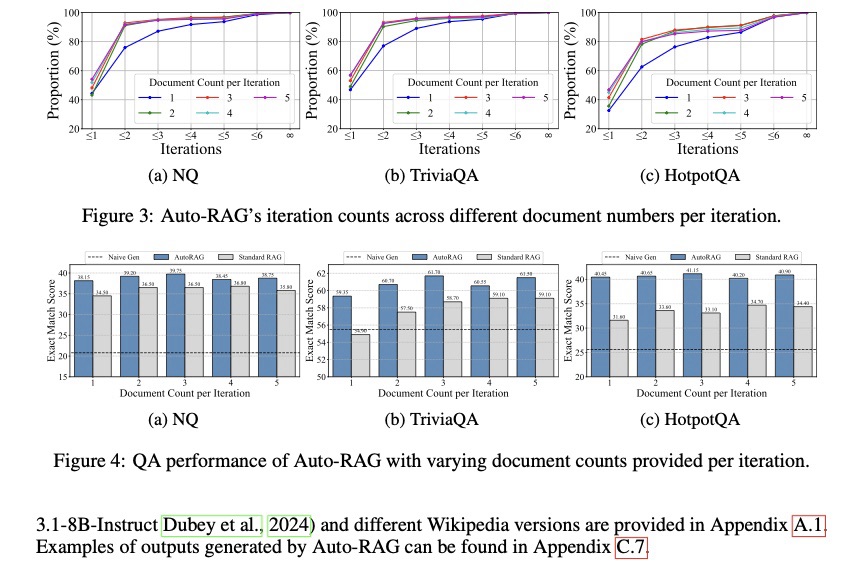
The paper “Auto-RAG: Autonomous Retrieval-Augmented Generation for Large Language Models” introduces an innovative approach to enhance Retrieval-Augmented Generation (RAG) systems by leveraging the decision-making capabilities of Large Language Models (LLMs). The authors propose an autonomous iterative retrieval model, Auto-RAG, which engages in multi-turn dialogues with retrievers to systematically plan retrievals and refine queries, thereby acquiring valuable knowledge. This process continues until sufficient external information is gathered to generate a final answer.

From the methodologies and strategies discussed in the paper, we can extract the following five patterns:

1. Autonomous Iterative Retrieval: Auto-RAG enables LLMs to autonomously decide when and what to retrieve through reasoning, engaging in multi-turn dialogues with retrievers to systematically plan retrievals and refine queries.

2. Reasoning-Based Decision-Making: The model employs reasoning for retrieval planning, extracting valuable external knowledge, identifying information needs, and rewriting queries, effectively leveraging the remarkable reasoning and decision-making abilities of LLMs.

3. Dynamic Adjustment of Iterations: Auto-RAG can autonomously adjust the number of retrieval iterations based on the difficulty of the questions and the utility of the retrieved knowledge, without requiring any human intervention.

4. Natural Language Interpretability: The iterative retrieval process is expressed in natural language, enhancing interpretability and providing users with a more intuitive experience.

5. Fine-Tuning with Synthesized Instructions: The authors develop a method for autonomously synthesizing reasoning-based decision-making instructions in iterative retrieval and fine-tune the latest open-source LLMs to empower them with autonomous decision-making capabilities.

These patterns collectively contribute to the effectiveness of Auto-RAG in improving the performance of RAG systems across various benchmarks.

Here are five l patterns that align with the concepts

Pattern Name: Iterative Retrieval Optimization

Pattern Type: Decision-Augmented Retrieval

Context/Background:

When interacting with a vast corpus of documents, LLMs may need multiple iterations of refined query processing to retrieve the most relevant information. However, a non-optimized retrieval loop can lead to inefficiencies.

Forces:

• Need for high precision in retrieval without overwhelming latency.

• Trade-offs between retrieval accuracy and computational cost.

Solution Overview:

Integrate iterative refinement steps where the LLM evaluates and adjusts its query parameters dynamically based on intermediate results, optimizing future retrievals.

Actionable Steps:

1. Generate the initial query.

2. Retrieve preliminary documents or snippets.

3. Evaluate retrieved information for relevance.

4. Update query with refinements based on evaluation.

5. Repeat steps 2-4 until an objective threshold is met.

Pattern Name: Auto-Retrieval Decision Loops

Pattern Type: Adaptive Automation

Context/Background:

LLMs can act as decision-makers in an autonomous retrieval system, selecting retrieval pathways dynamically. Without clear decision loops, retrieval can become misaligned with the user’s goals.

Forces:

• Trade-off between maintaining autonomy and user guidance.

• Risk of losing context fidelity over multiple iterations.

Solution Overview:

Embed clear decision loops into retrieval processes, where the LLM autonomously decides on query refinements or terminates iterations when goals are met.

Actionable Steps:

1. Define a goal for the retrieval task.

2. Execute initial retrieval.

3. Evaluate results and decide to refine, expand, or terminate.

4. If refine or expand, re-run with updated context.

5. Terminate when the relevance exceeds the threshold.

Pattern Name: Context-Driven Weight Adjustment

Pattern Type: Contextual Retrieval Optimization

Context/Background:

When integrating LLMs with RAG models, the model must prioritize documents based on relevance while managing noisy data sources.

Forces:

• Relevance degradation due to broad query parameters.

• Inefficient utilization of computational resources.

Solution Overview:

Utilize LLMs to adjust the weights of retrieved documents dynamically, prioritizing contextually relevant results in subsequent iterations.

Actionable Steps:

1. Retrieve documents from the initial query.

2. Score documents based on contextual relevance.

3. Adjust weights dynamically and re-rank documents.

4. Use re-ranked documents to refine the next iteration.

Pattern Name: Autonomous Query Generation

Pattern Type: Query Adaptation Pattern

Context/Background:

Standard retrieval systems rely on static or pre-defined queries. Autonomous query generation enhances the RAG model by dynamically altering queries for better alignment with evolving retrieval goals.

Forces:

• Difficulty in predicting the most effective initial query.

• Need to adapt queries for diverse and complex domains.

Solution Overview:

Use the LLM to autonomously generate queries in iterations, guided by intermediate results and goal alignment metrics.

Actionable Steps:

1. Analyze user input and objectives.

2. Generate an initial query using contextual embedding.

3. Retrieve and evaluate results.

4. Generate a refined query based on result gaps.

5. Iterate until desired outcomes are achieved.

Pattern Name: Hierarchical Retrieval Pathways

Pattern Type: Multi-Stage Retrieval Framework

Context/Background:

Retrieval processes often require navigating multiple layers of information, where each layer informs the next. Without hierarchy, retrieval results may lack depth.

Forces:

• Need to balance broad exploratory retrieval with focused deep dives.

• Difficulty maintaining coherence across retrieval layers.

Solution Overview:

Design retrieval pathways in hierarchical stages, with each stage progressively refining the scope of results using LLM-guided criteria.

Actionable Steps:

1. Conduct a broad exploratory search.

2. Cluster results by thematic categories.

3. Use clusters to inform focused, in-depth queries.

4. Iterate with refined scopes until goals are met.

Source : https://arxiv.org/abs/2411.19443

Uncategorized

The integration of the Population Dynamics Foundation Model (PDFM) with the concept of Deep Context offers a transformative approach to analyzing geospatial dynamics by emphasizing causality, iterative reasoning, and adaptive planning. Here’s how this integration works and how it leverages “deep context”:

PDFM as the Foundation

PDFM generates location embeddings by combining:

1. Human behavior data (e.g., search trends, busyness levels).

2. Environmental data (e.g., weather, air quality).

These embeddings are contextual snapshots of dynamic populations, capturing complex geospatial relationships via graph neural networks (GNNs).

Deep Context in Population Dynamics

Deep context involves widening the aperture of context to understand causality and refine conclusions iteratively. This is achieved by:

1. Maximizing and minimizing competing objectives (e.g., accurate data modeling vs. predictive generalization).

2. Adaptive learning to uncover latent patterns in population dynamics.

By applying deep context to PDFM, we introduce self-corrective iterations:

• An initial model might only use localized data, leading to narrow insights.

• With each iteration, expanded geospatial factors (like historical trends, adjacent region data, or policy impacts) are incorporated to enhance predictions and refine causal understanding.

Key Integration Points

1. Causal Insights:

• PDFM embeddings model “what is happening,” while deep context answers “why it is happening.”

• Iterative modeling adds layers of context, such as the socio-political drivers of unemployment or climate change effects on health metrics.

2. Iterative Refinement:

• PDFM’s GNN architecture benefits from deep context’s objective balancing, identifying trade-offs (e.g., interpolation accuracy vs. forecasting generalizability).

• Over iterations, embeddings adapt to incorporate more nuanced relationships.

3. Cross-Domain Insights:

• Deep context enables the blending of data across domains (e.g., integrating health data into socioeconomic forecasting).

• PDFM, guided by a deep context framework, moves from static snapshots to dynamic, causally-aware predictions.

Application Scenarios

1. Disaster Response:

• PDFM predicts evacuation behaviors based on search and activity data.

• Deep context integrates additional causal layers, like pre-existing socioeconomic vulnerabilities, enabling better resource allocation.

2. Public Health:

• PDFM forecasts disease spread with weather and mobility data.

• Deep context broadens insights by linking these trends to healthcare infrastructure, policy decisions, or historical epidemics.

3. Economic Planning:

• PDFM models poverty trends using embeddings.

• Deep context explains these shifts by analyzing policy impacts, inflation rates, and cross-regional trade dynamics.

Conclusion

The integration of PDFM with deep context transforms geospatial modeling into a causally-driven, iterative reasoning process. It moves beyond static predictions to uncover adaptive, actionable insights, making it invaluable for industries like public health, environmental science, and urban planning. This combination exemplifies how foundation models and context-driven frameworks can work symbiotically to redefine decision-making in dynamic, multi-faceted environments.

The paper “General Geospatial Inference with a Population Dynamics Foundation Model” introduces the Population Dynamics Foundation Model (PDFM), a versatile machine learning framework designed to enhance geospatial analysis across various domains. Key contributions of this work include:

1. Integration of Diverse Data Sources: PDFM constructs a geo-indexed dataset encompassing aggregated human behavior data—such as maps, busyness metrics, and search trends—alongside environmental factors like weather and air quality. This comprehensive dataset enables a holistic understanding of population dynamics.

2. Graph Neural Network Architecture: Utilizing a graph neural network (GNN), PDFM effectively models complex spatial relationships between locations. This approach facilitates the generation of embeddings that are adaptable to a wide range of geospatial tasks, including interpolation, extrapolation, super-resolution, and forecasting.

3. State-of-the-Art Performance: The model demonstrates superior performance across 27 downstream tasks spanning health indicators, socioeconomic factors, and environmental measurements. It surpasses existing satellite and geotagged image-based location encoders in geospatial interpolation and achieves state-of-the-art results in extrapolation and super-resolution for 25 of the 27 tasks.

4. Enhancement of Forecasting Models: By combining PDFM with the TimesFM forecasting model, the research achieves improved predictions for socioeconomic indicators such as unemployment and poverty. This integration results in performance that exceeds fully supervised forecasting methods.

5. Open Access Resources: The authors have made the full set of embeddings and sample code publicly available, encouraging further research and application in understanding population dynamics and geospatial modeling.

These contributions collectively advance the field of geospatial inference, providing a robust tool for analyzing complex population dynamics across various sectors.

Uncategorized

Five patterns for fair tournament design

Pattern 1: Incentive-Compatibility in Tournament Design

• Pattern type: Tournament Rule Structuring

• Context: In tournaments, participants sometimes have incentives to manipulate results for strategic advantage, compromising the fairness and integrity of outcomes.

• Forces:

• Integrity of Competition: Ensure that outcomes reflect true performance rather than collusive strategies.

• Player Motivation: Reduce motivations to engage in behaviors contrary to the spirit of fair play.

• Predictability: Design rules to discourage unpredictable or manipulated match outcomes.

• Solution Overview: Implement rules that align player incentives with genuine competition, reducing the potential for collusion.

• Steps:

1. Identify common forms of manipulation in tournament settings.

2. Determine potential incentives that lead to strategic manipulation.

3. Develop rule adjustments that reduce these incentives.

4. Simulate outcomes under the new rules to test effectiveness.

5. Refine rule structure based on simulated and real-world outcomes.

• Implementation: Use algorithms to predict potential manipulation strategies and assess rule changes.

• Consequences: Reduced strategic manipulation; however, complete elimination of incentives may be impossible.

• Related Patterns: Fair Play Enforcement, Predictive Behavior Modeling.

Pattern 2: Collusion-Resistance in Match Setup

• Pattern type: Game Theory in Sports

• Context: Collusion can occur when tournament structures allow teams to benefit from coordinating match results.

• Forces:

• Fairness: Prevent unfair advantages gained through collusion.

• Game Integrity: Maintain credibility in match outcomes.

• Spectator Trust: Protect audience belief in competitive integrity.

• Solution Overview: Structure match setups and scoring to reduce opportunities for collusion.

• Steps:

1. Analyze past instances of collusion to identify structural weaknesses.

2. Create a scoring system where collusion provides minimal or no benefit.

3. Implement randomization elements that make collusion harder.

4. Monitor for unusual scoring or patterns indicating potential collusion.

5. Adjust based on observed results and feedback.

• Implementation: Test rule changes with simulations, using historical data to calibrate systems.

• Consequences: Decreased likelihood of collusion, though some strategic manipulations may still be possible.

• Related Patterns: Anti-Collusion Mechanisms, Predictive Surveillance.

Pattern 3: Maximizing Competitiveness without Encouraging Manipulation

• Pattern type: Competitive Balance in Tournament Design

• Context: A balanced tournament design should encourage close competition without incentivizing teams to manipulate outcomes.

• Forces:

• Competitive Spirit: Encourage teams to compete sincerely.

• Balance: Avoid rules that give undue advantage or disadvantage based on match order.

• Resilience to Manipulation: Ensure structural robustness to exploitative strategies.

• Solution Overview: Adjust point allocations and match sequencing to avoid advantages tied to game outcomes.

• Steps:

1. Map out various competitive scenarios and assess how rules impact match incentives.

2. Design a scoring system that rewards performance consistently.

3. Set match orders to neutralize any strategic advantage from game sequencing.

4. Use algorithms to simulate the effects of rule changes on real and theoretical games.

5. Continuously iterate based on feedback and observed manipulations.

• Implementation: Regularly update scoring algorithms to adapt to evolving strategies.

• Consequences: Reduced opportunities for exploitation, but may require constant adjustments.

• Related Patterns: Equitable Scoring, Anti-Exploitative Game Structures.

Pattern 4: Trade-off in Fairness Constraints

• Pattern type: Fair Play Rule Optimization

• Context: Attempting to meet multiple fairness criteria often reveals trade-offs where satisfying one criterion may hinder others.

• Forces:

• Balance: Ensuring fair play while maintaining competitiveness.

• Complexity: Balancing simple rule design with comprehensive fairness.

• Robustness: Mitigating unintended advantages that arise from rule interactions.

• Solution Overview: Use optimization frameworks to balance competing fairness criteria in rule design.

• Steps:

1. Identify the fairness criteria essential to tournament structure.

2. Set priorities among these criteria to guide trade-off decisions.

3. Use algorithmic models to explore the impact of prioritizing different criteria.

4. Adjust the rule framework to achieve optimal balance.

5. Evaluate outcomes to ensure fairness goals are met effectively.

• Implementation: Periodically reassess trade-offs as new manipulation tactics emerge.

• Consequences: May need to sacrifice certain fairness aspects for others; requires ongoing balancing.

• Related Patterns: Optimization of Fairness, Adaptive Rule Design.

Pattern 5: Algorithm-Driven Rule Testing

• Pattern type: Data-Driven Tournament Optimization

• Context: Effective tournament rules require extensive testing to identify and mitigate loopholes.

• Forces:

• Accuracy: Accurately predict likely player behaviors and potential exploitations.

• Adaptation: Enable real-time adjustments based on observed game data.

• Scalability: Apply rule testing across various tournament types and scales.

• Solution Overview: Leverage algorithmic simulations to stress-test rules under diverse scenarios.

• Steps:

1. Develop a model to simulate typical tournament dynamics.

2. Integrate rule parameters into the model to test different configurations.

3. Use machine learning to detect patterns indicating potential rule vulnerabilities.

4. Iterate on rules based on simulation results.

5. Test with live tournaments to refine based on real-world dynamics.

• Implementation: Run parallel simulations and continuously update rules based on data insights.

• Consequences: Greater confidence in rule robustness but requires computational resources and iterative improvements.

• Related Patterns: Simulation-Based Rule Testing, Dynamic Rule Adjustment.

We highlight a different aspect of designing tournament structures that are resistant to manipulation, leveraging algorithmic insights and iterative design.

References

http://research.google/blog/can-algorithms-make-sports-tournament-cheating-obsolete/